The Tire Analogy
Frictionless tires mean infinite acceleration but zero steering. Friction is what translates engine power into actual, navigable movement.
Episode 4 • March 26, 2026
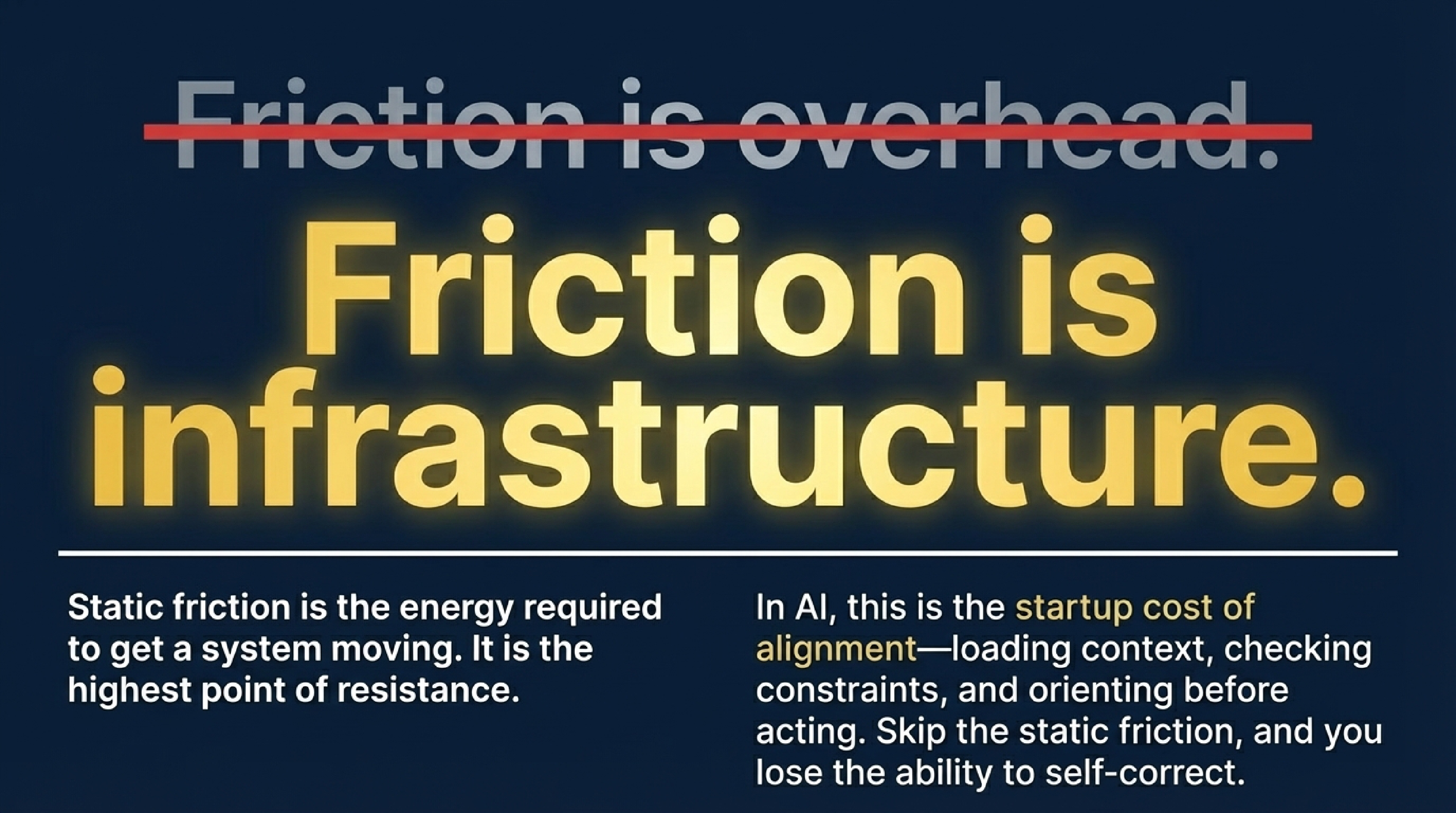
The entire AI industry assumes friction is overhead to be eliminated. We argue that cognitive friction is the structural infrastructure that prevents systemic collapse.
If you build a car with frictionless tires, the engine accelerates infinitely, but you have zero steering and no braking. You don't have a vehicle. You have a missile. Making intelligence cheaper does not reduce its cost; it multiplies its demand until the system breaks.
Watch
A context window operating without friction becomes a hallucination trap. By introducing deliberate, constitutional delays—requiring an agent to pull its bearing before it answers—we trade minor speed for major stability. The pause is not a flaw; it is the steering wheel.
Concept
Jevons Paradox states that making a resource more efficient increases its total consumption rather than decreasing it. Making AI inference frictionless means we generate infinitely more garbage noise, drowning out the actual signal. Tribology—the science of friction—teaches us that surfaces require precise resistance to function.
Frictionless tires mean infinite acceleration but zero steering. Friction is what translates engine power into actual, navigable movement.
Cheap, frictionless answers don't solve our problems; they merely multiply the volume of low-quality, hallucinatory output.
Bearingfield introduces deliberate cognitive friction (Registration Before Reasoning) to ensure the system anchors to reality before generating.
Friction is not overhead. It is the infrastructure that keeps the ship from tearing itself apart.
Materials
Explore the specific architecture that manages informational friction.